My well-packed bicycle is down in the baggage compartment, but it will take some more time before I can unpack it from its cardboard box. My connecting flight to Belém, in the north of Brazil, will leave only late in the evening. This gives me enough time to catch the next bus in front of the terminal to escape to the other end of the city, to the places where the "Cidade Maravilhosa", the marvelous city, truly lives up to its name, to the beaches of Copacabana and Ipanema.
I feel very tired after the long overnight flight, yet even that early in the morning, I already have to fend off some rather ambiguous offers from overly friendly ladies. It is quite warm but cloudy, so that today, except for the ladies working here "with tourists", hardly any Cariocas can be found.
Fortunately, I have an appointment for the afternoon. I am meeting with Lucia, a cyclist from Rio whom I connected with while preparing for this tour on the internet. After a quick phone call to arrange the exact meeting point (fortunately, the beach bars are numbered, so that it is almost impossible to miss each other) Lucia takes me to an excellent Churrascaria in Ipanema. For those who don't know, let me explain: A Churrascaria is a nightmare for every vegetarian. Only to show your good manners, you help yourself to some salad and vegetables from the buffet. Then you sit and wait. The waiters pass by with huge skewers of meat, roasted over an open fire, and cut fresh pieces of all kinds of meat directly onto your plate. Apart from a healthy appetite, the only way to defend against the attack of the waiters is a kind of traffic light, that is, a red and green card or piece of wood which you can flip over to the red side in order to surrender.
At night, I continue on to Belém. Yet another 3 or 4 uncomfortable hours in economy class. Now, I am really looking forward to riding my bike.
Walking out of the air-conditioned terminal is a bit of a shock. It is already midnight, but still 30°C and very humid. Instead of assembling my bike and cycling 15 km in the darkness, I opt for a taxi to reach a hotel in downtown Belém.
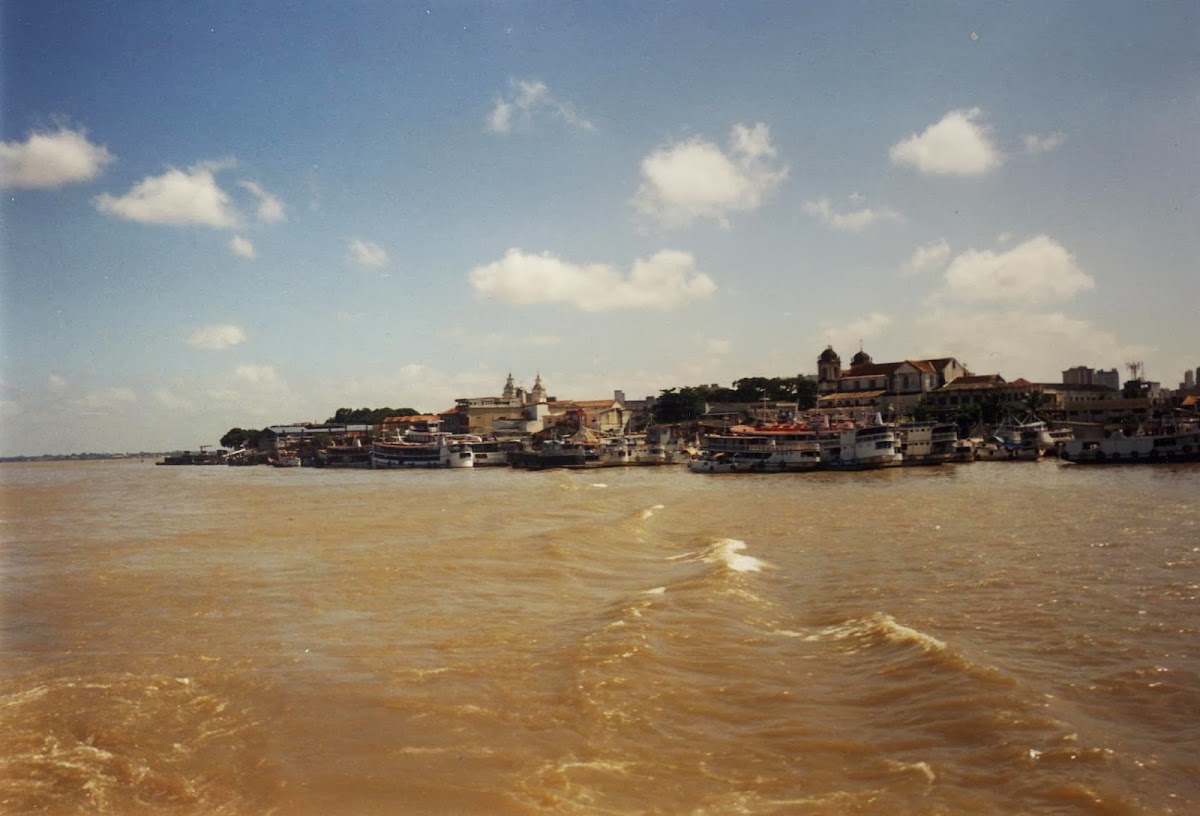
I grant myself another easy day on the beach. The beach is actually not by the sea but on the Tocantins River, a smaller tributary of the Amazon system. ("Small" in Amazonian terms still means roughly double the size of the Mississippi) It's quite a strange feeling to swim in that river, with heaven knows what kind of fish are in there.
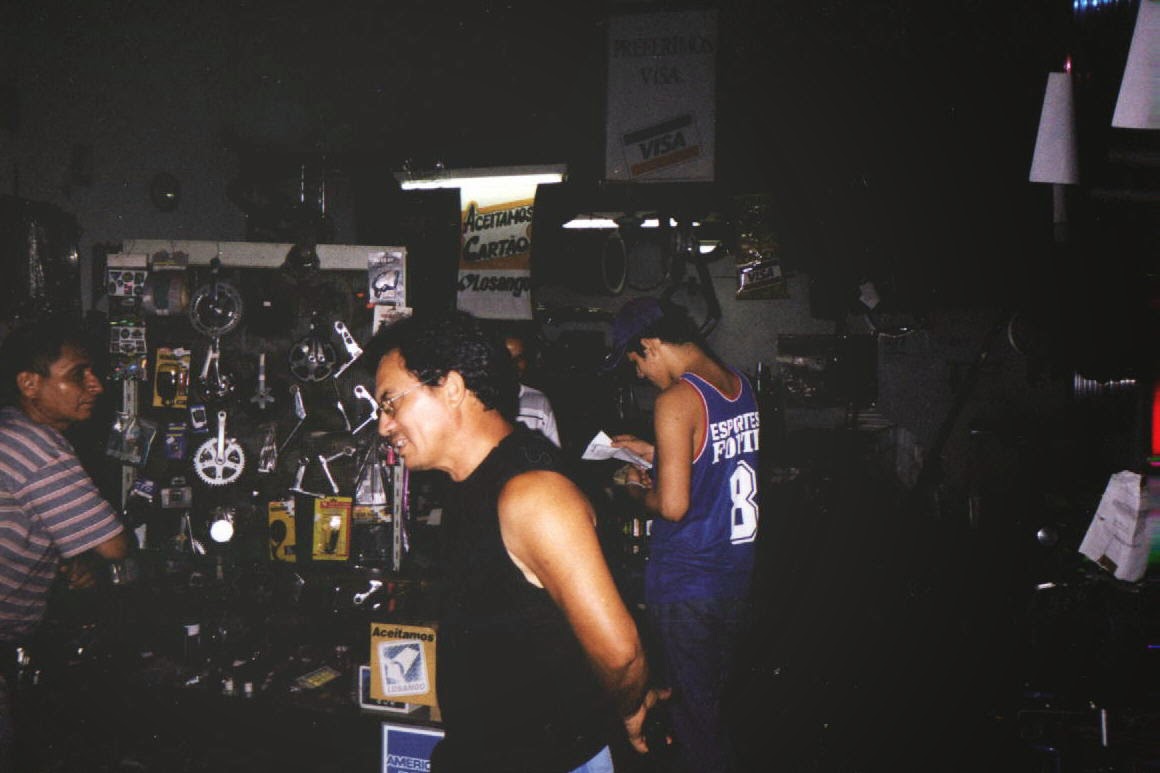
The following morning, they show me the sights of their city and help me buy supplies. My shopping list is long, because to this day, no one has been able to tell me exactly what the situation is like along the Trans-Amazonian Highway. The information given differs from "excellent" to "impasable" to "no longer exists". So, I have to buy sufficient food for the worst case scenario - for 10 days or so - and the bags I carry back to the hotel are very heavy.
Before they say goodbye, my new friends show me the departure point of the Rio Capim ferry, where my tour is supposed to start tomorrow morning. Very nice guys.
Finally, I am ready to depart, and early in the morning, I leave the hotel to the applause and farewells of the hotel staff and guests.
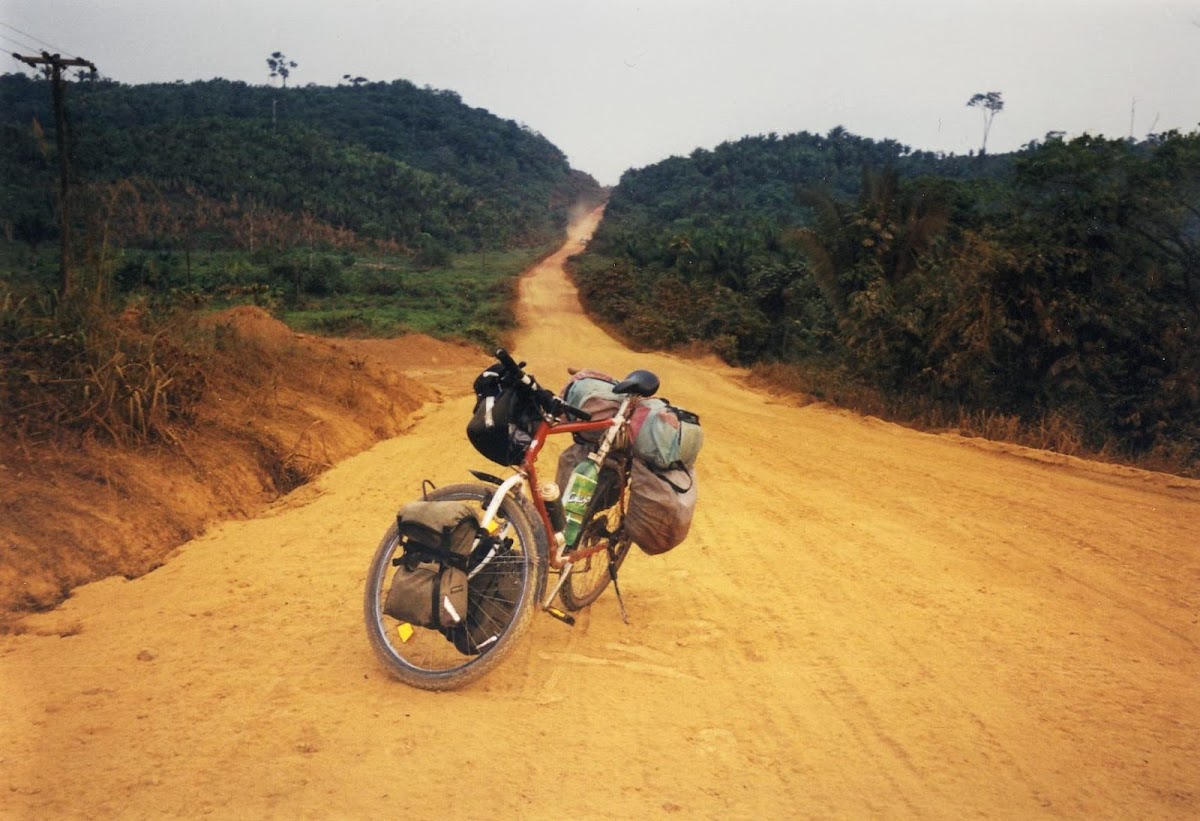
The uncertainty begins somewhere over there. First of all, I have to go south for 400 kilometers in order to reach the official Trans-Amazonica, which runs from east to west. The first 300 km are on a paved road and shouldn't be a big problem. Then, I want to catch a small side road shown on my map, but for that section, I have even less information than for the rest of the Transamazonica.
The travel time to the other side of the river is more than half an hour, and by the time I get there, the heat is already incredible. I am still accustomed to the lovely 15°C at home, so these 35°C here are intense... At noon, the sun shines exactly from overhead, and there is no shadow. Well, I try to do my best, but I have to stop every 30 minutes or so to swim in one of the thousands of rivers or to have a cold drink in one of the few bars on the roadside.
I am surprised to discover so much greenery so close to Belém, with its millions of inhabitants. The State of Pará is infamous for its environmental policy. Large portions of the state are sold to large, international companies, which can basically do whatever they want. Perhaps in this particular part, it is simply too swampy for cattle, or there might be some other reason why no one has cleared the annoying forest.
I cover no more than 100 km the first day, and I am so exhausted that I can hardly set up my tent. Setting up a tent is not so easy in this part of the world... It takes me more than 15 minutes to clear some space in the jungle. Once I have done this, I just crawl into my tent and fall asleep. No sleeping bag is needed here anyway. I wake up several times at night to some strange noises around my tent, but I don't care that much. Are there any dangerous animals in the rainforest?
As I do so often during the day, I stop at a small river to cool down and rinse my shirt, when I notice another cyclist with a small backpack passing by. He sees my bike parked up on the road and stops to say hello. Unlike me, he's not cycling for fun. He has been working for several months in Marabá (some 400 km south of Belém) and is now on his way home to Belém, saving the money for the bus ticket by cycling. He asks what the hell I'm doing here, but it would be impossible to explain to him that I have spent 10 of his monthly salaries just to fly 10,000 km to Belém and cycle around for my personal entertainment. He drinks some water from the river (where I have just washed my shirt) and then continues his journey.
For cool drinks, I still prefer to stop at the small bars which you find now and then, usually completely unexpectedly, on the roadside. A cold beer on an empty stomach is amusing and facilitates proper Portuguese pronunciation. Contrary to my thirst, my hunger is very low. I have eaten almost nothing over the last few days, but nevertheless, I'm not hungry at all. For some reason, I do not long for nourishment in the form of food.
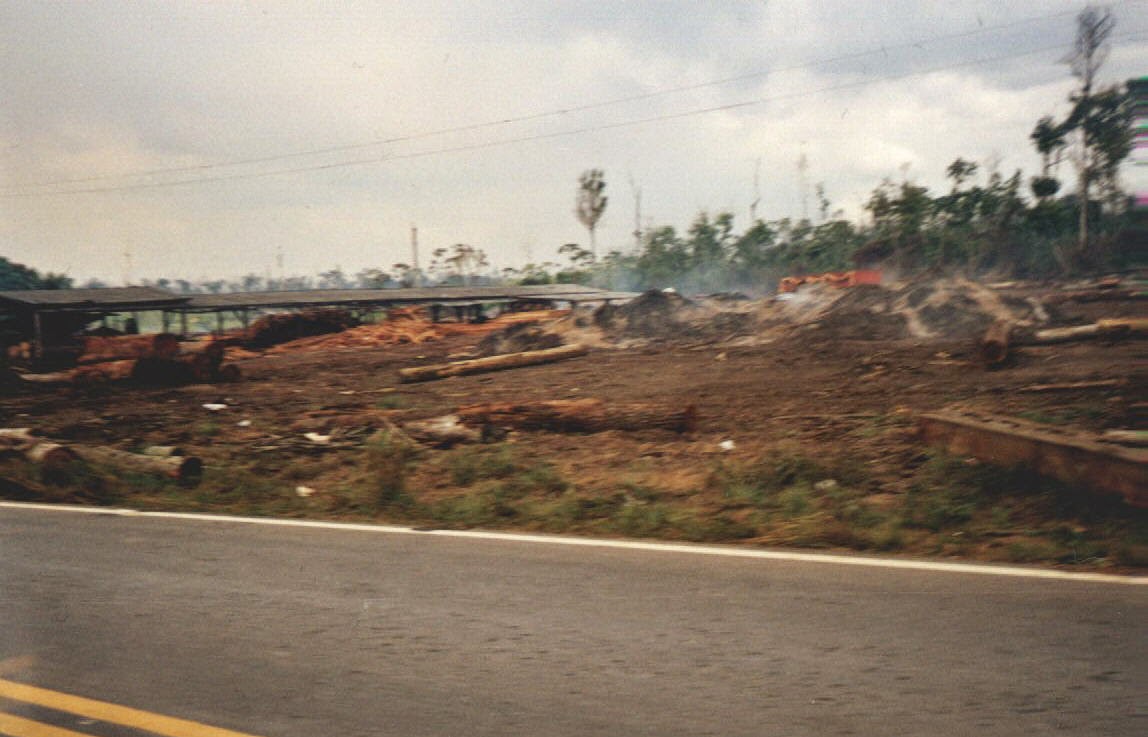
The landscape further south is becoming more and more deserted. There are fewer houses, but the forest is also disappearing for most of the way. I cycle for long stretches along areas that seem to be a desert rather than a rainforest. It is not flat anymore; I am already entering the Serra dos Carajás. This is where the world's largest iron ore mine is situated, which is why they have cut down all the trees to produce charcoal for steel production.
The hills are not very high, but they are very steep. I have to get off the bike and push. The heat comes up from my feet and along my whole body; I have only hot water to drink, and I feel like a sausage on a summer barbecue.
The people are extremely friendly, and most of them are very curious. But sometimes it's difficult to understand them. They speak with a very strange accent in some rural areas. However, some of them just stare at you like you are from another planet, saying nothing at all.
What happened yesterday must be another Murphy's Law: "If it's terribly hot and you wish for some refreshment, it will not rain as long as you are on a paved road" and "It will rain as soon as you reach the dirt road." And so it is. After three days of sunshine, it starts raining exactly when I reach the end of the pavement. Exactly!! On the minute!
It continues raining for the whole afternoon, and after a while, I give up. There is a small bar at the roadside, and a truck driver who stops there offers to bring me uphill to town, some way off the main road. Tucuruí is a nice town on the Tocantins river, where they have built one of the world's biggest river dams, in the middle of the Amazon. I did not plan to stop in Tucuruí, but under these conditions, it makes no sense to go on. The owner of the bar kindly offers to store my bicycle until my return, and so I accept the ride.
Here I am now, in Tucuruí, Pará, in the middle of nowhere, but with internet access and air conditioning, and 2,500 km to go.
Next message probably in two weeks from Santarém or Itaituba.
Até logo
Micha
 The following text was written on tour on Oct. 22nd, 1999 in Tucuruí, Brazil and originally posted on the
Touring@phred.org
The following text was written on tour on Oct. 22nd, 1999 in Tucuruí, Brazil and originally posted on the
Touring@phred.org
After a long overnight flight, I arrive at sunrise at Rio International Airport.